Repeat Performance

Repeat Performance

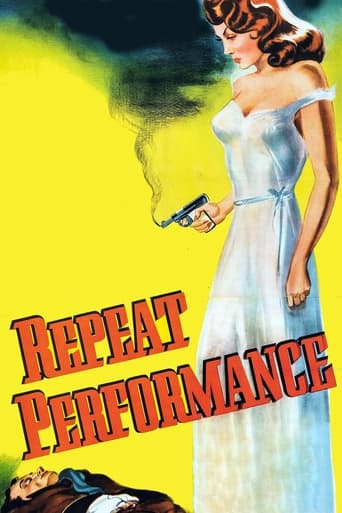
Time stopped in its tracks... when she pulled the trigger!
1947Drama, Fantasy, Crime1h 31m6.1NR
On New Year's Eve 1946, Sheila Page kills her husband Barney. She wishes that she could relive 1946 and avoid the…
Directed by Alfred L. Werker 22 May 1947 · Jestha 9, 2004 BS United States of America

Storyline

On New Year's Eve 1946, Sheila Page kills her husband Barney. She wishes that she could relive 1946 and avoid the mistakes that she made throughout the year. Her wish comes true but cheating fate proves more difficult than she anticipated.

Facts

Keywords

new year's evebased on novel or bookfilm noirfatetime loopb movie

Explore cinema

Trailer

Repeat Performance (1947) | Starring Joan Leslie - Clip [HD]

Cast 33

Videos 1

Backdrops 10

Posters 12

Reviews 2

  • S Steve27 Dec 2016 6/10

    www.filmnoiroftheweek.com

    Film noir and The Twilight Zone have more in common than you'd probably think. B-movie actors from the 40s peppered the casts of Twilight Zone episodes almost 20 years later. Dutch angles magnify tension; and other impressive black and white photography (at least before the Twilight Zone started to shoot on video late in the series) on the CBS show could easily be mistaken for a classic noir. Watch the credits at the end of a TZ and you'll see many names sometimes associated with film noir: Harry J. Wild, Joseph LaShelle, John Brahm, Richard Florey to name a few.

    Of course the fantasy/sci-fi element of the Twilight Zone are usually not found in noirs. The exceptions being Val Lewton's RKO horror films and the New Years Eve thriller, Repeat Performance.

    Repeat Performance was released in 1947 by Eagle-Lion films who at the time were trying to establish themselves as a major force in Hollywood. They put out some “nervous As” – not cheap enough to be Bs but not expensive enough to be As. Repeat Performance fits that description.

    Clunky and far-too-dramatic opening credits leads to a classic noir open, then a cheapish looking movie filled with former stars (Louis Hayward) and actors just starting out (Richard Basehart in his first film roll.) Repeat Performance may be a bit too full of soapy dramatics to be a top-shelf noir, but it certainly could be served to noir fans without complaint. The fantastic looking – dark and stylish – opening and end of the film more than make up for the frothy middle – and for me makes the film a worthy entry in the film noir classic period.

    Despite its obvious flaws – and it really is probably only loved by fans of old black-and-white mysteries --it's one of my favorite New Years Eve tales.

    Encore!

    Just before midnight on New Year's Eve, 1946, Broadway actress Sheila Page (Joan Leslie) shoots her husband Barney (Hayward) and then rushes to see her friend, odd-ball poet William Williams. After a distressed Sheila confesses her deed to William (Basehart), he suggests they talk to Sheila's producer John Friday (Tom Conway). As Sheila and William are walking up to John's apartment, Sheila wishes that she could relive the past year, insisting that if she had it to do over, she would not make the same mistakes twice. Upon reaching John's door, Sheila notices that William has

  • John Chard5 May 2019 8/10

    Run Through Snow Leaving No Footprint.

    Repeat Performance is directed by Alfred Werker and adapted to screenplay by Walter Bullock from the novel written by William O'Farrell. It stars Louis Hayward, Joan Leslie, Tom Conway, Richard Basehart, Virginia Field and Natalie Schafer. Music is by George Antheil and cinematography by L. William O'Connell.

    It's New Years Eve 1946 and Sheila Page is standing over the dead body of her husband - with gun in hand. Hurrying to a party to seek solace from friends, Sheila wishes she could turn back the clock and eradicate the problems that the year has thrown at her. Amazingly she gets the chance to do just that...

    Destiny's a stubborn old girl Sheila.

    It's the sort of story that would be at home in The Twilight Zone some years later, a fantastical premise involving time travel that still has the bitter requisite of fate standing firm to not be cheated. It seems that no matter what Sheila Page (Leslie) does, her year of misery, and that of the people closest to her, can not be averted. This set up makes for a number of involving scenes as we the viewers yearn for Sheila to achieve her goals. Pic slots into the noir realm since it drips with pessimism, while the central characters (failure of a husband, femme fatale, frustrated poet) have all hoped off the bus from noirville. It mat get too soapy at times throughout the middle section, but there's no grandstanding drama to have you rolling your eyes.

    Visually it has great moments, notably for the tremendously shadowy finale when story saunters to the conclusion of everything we have just witnessed. There's also a super section where Sheila is visiting a friend at a mental asylum, as she talks (the conversation richly dark) the reflection on the wall behind her is that of a barred window with rain cascading downwards, the metaphor for discord is palpable and a smart touch. Conversely these great visual moments have you wishing that more were within the whole picture, something Werker would achieve a year later with the excellent He Walked By Night (Basehart in the lead). George Antheil's (The Sniper/In A Lonely Place) musical compositions are most interesting, particularly during that finale as he bounces strings and woodwind from the action to that of the ticking New Years Eve clock. Cast are fine, Leslie pitches it right as the woman fighting fate head on, Ha


More like this

TMDB χ Niguro, Credits to all contributors.