

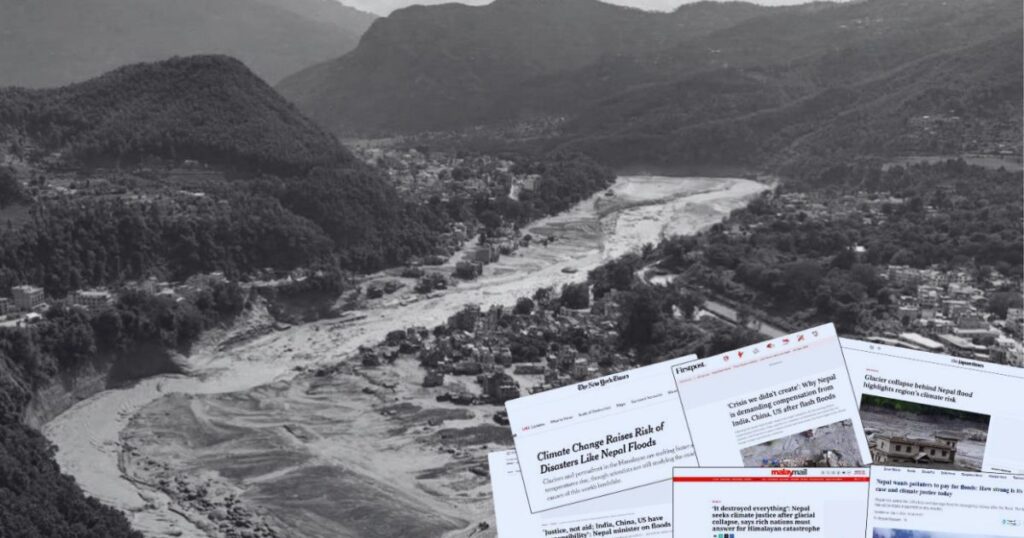
Nepal has formally lodged a claim with the United Nations Fund for Responding to Loss and Damage, demanding financial redress for billions of dollars in destruction unleashed by recent catastrophic floods in the northern district of Rasuwa.
The formal submission on 4 September 2026 (19 Bhadra 2083) marks a pronounced shift in Kathmandu’s diplomatic posture, pivoting from appeals for humanitarian assistance toward an explicit demand for legal and moral reparations from the world’s primary greenhouse gas polluters.
According to World Bank data, Nepal emits just 0.54 metric tons of carbon dioxide per capita annually, a negligible fraction of the global average of 4.67 tons, and far below the 13.6 tons per capita produced by the United States or China’s 9.3 tons. Despite contributing almost nothing to global atmospheric warming, the Himalayan nation faces acute, disproportionate consequences as its glacial infrastructure destabilizes.
Foreign Minister Shishir Khanal emphasized the policy shift, stating that climate diplomacy must transition from seeking voluntary aid to securing formal restitution. This is not a matter of charity, Khanal noted, but an issue of legal and moral responsibility. The position has been reinforced by head of government statements insisting that the international community, having generated the emissions driving these crises, bears an inescapable obligation to finance mitigation and recovery in frontline states.
Mechanics of Collapse
The devastation in Rasuwa has attracted intense scrutiny from earth scientists analyzing the convergence of factors behind the catastrophe. Satellite assessments indicate that the disaster began as a massive displacement of snow, weakened rock, and degraded permafrost on the upper slopes within Nepal before breaching borders and cascading down river valleys on both sides of the frontier.
Researchers pointing to the mechanics of high-altitude collapses suggest that friction generated by high-volume rockfalls can generate immense heat, rapidly melting snowpacks and converting debris into high-velocity slurry. Regional analysts noted the torrent traveled an estimated 170 kilometers, behaving essentially like an inland tsunami that wiped out settlements, transport links, and vital infrastructure downstream.
The broader scientific consensus highlights the vulnerability of the Hindu Kush Himalaya, an eco-region warming at nearly double the global rate. United Nations records document that the pace of Himalayan glacial retreat accelerated by 65 percent between 2010 and 2020 compared to the preceding decade, raising the threat profile of glacial bursts and flash floods.
Geologists warn that permafrost, which historically acted as a frozen binding agent holding steep scree and bedrock together, is thawing rapidly under persistent warming. The structural integrity of high-altitude slopes has also been degraded by past seismic activity, including legacy fractures from the 2015 Gorkha earthquake (2072 BS), leaving steep valleys primed for catastrophic failure.
Infrastructure and Geopolitics
While atmospheric warming provides the foundational hazard, experts caution against viewing the catastrophe purely through a climatic lens. The fragile ecology of the Himalayas has been placed under unprecedented physical stress by rapid infrastructure expansion across Nepal, India, and China.
Hydropower dams, deep tunnels, railway links, and highways built along steep river corridors have altered slope dynamics and constricted natural drainage basins. In the trans-Himalayan belt, projects such as China’s series of dams along the Yarlung Tsangpo and extensive Indian infrastructure ventures across the frontier in Arunachal Pradesh illustrate the intensive industrial footprint encroaching on fragile highlands. Geospatial specialists warn that altering an already hyper-sensitive geological system exponentially magnifies the damage when sudden floods occur.
A Test of Fund Solvency
The formal petition by Kathmandu brings immediate scrutiny to the institutional mechanics of the UN Loss and Damage framework. While created precisely to address irreversible impacts in vulnerable economies, the mechanism remains severely undercapitalized relative to the scale of real-world losses.
Pledges to the trust fund stood at roughly 822 million dollars by mid-May, with actual transferred receipts totaling around 456 million dollars—a sum dwarfed by Nepal’s single-event recovery estimates, which exceed the fund’s liquid assets by nearly ninefold.
As civic activists and Himalayan policymakers observe, incremental global temperature rises that appear abstract in international conference halls translate into structural collapse, economic ruin, and the loss of human lives across high-altitude communities that had virtually no role in warming the planet.


Replies
No replies yet. Log in to be the first to reply!